Author: Lucas Lu

  • Star Ruby Grapefruit

    Star Ruby Grapefruit

    🍊 Plant Profile: Star Ruby Grapefruit

    📋 Basic Info

    • Variety Name: Star Ruby Grapefruit (Inferred from its red blush, red flesh, and thin skin)
    • Planted Date: Early 2024
    • Yield Performance: ★☆☆☆☆ (Just catching its breath after severe pest damage last year, currently in recovery mode)
    • Taste Profile: The pinnacle of looks and flavor in the grapefruit family. It features incredibly thin skin with a gorgeous red blush and deep, ruby-red flesh. It’s overwhelmingly juicy with a perfect sweet-tart balance, lacking the strong bitter aftertaste of standard white grapefruits.

    📖 Variety Overview If you want to grow a grapefruit that is both delicious and beautiful in a backyard, Star Ruby is the ultimate choice for California growers.

    • Appearance: It has classic, vibrant green citrus foliage. Its biggest highlight is the fruit: under the intense summer sun of Rowland Heights, the rind develops a beautiful red blush, and slicing it open reveals an incredibly tempting dark red interior.
    • Growth Habits: It is a high-heat variety that thrives in the climate of Southern California’s inland valleys. The more heat it gets, the redder and sweeter the flesh becomes.

    📅 My Planting Log

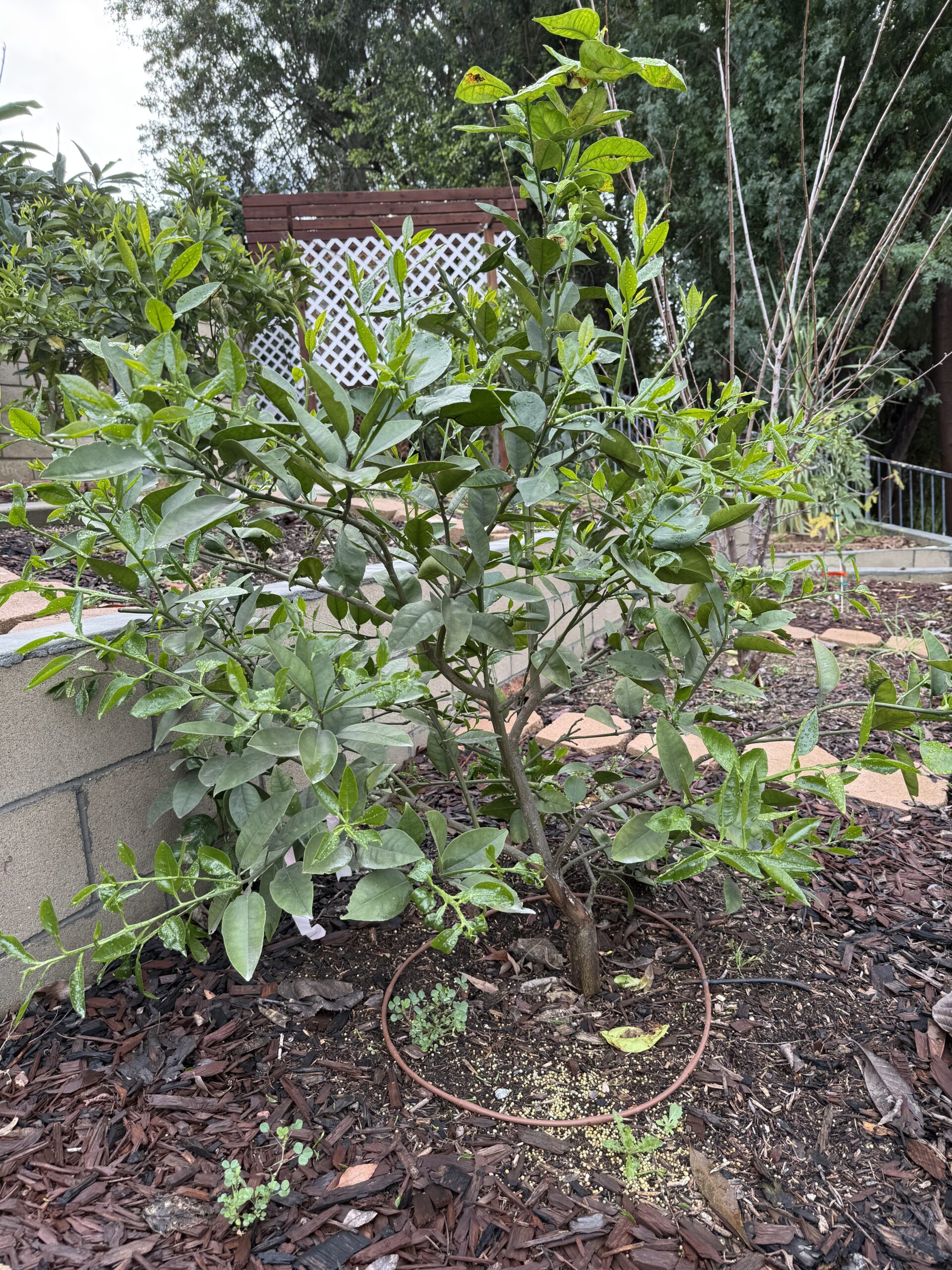
    • A Tough 2025: Planted with high hopes in early 2024, it was unfortunately heavily hit by the dual assassins of citrus trees in 2025: leafminers and aphids. The tender new leaves were chewed up and curled, severely stunting its growth progress.
    • The Spring Comeback: After a year of laying low, it has finally pushed out a full canopy of vigorous new shoots this early spring (2026). Although the annoying aphids tried to make a comeback, I took preemptive action and sprayed pesticide. Looking at these lush, lively new flushes in the photo, I am confident it will make a full recovery this year.

    🛠️ My Care Guide

    • Strict Pest Control: This is the make-or-break factor for its comeback this year. Fresh citrus flushes are an absolute feast for aphids and leafminers. During this spring growth spurt, I will maintain a spraying schedule of Neem oil or gentle pesticides every 1-2 weeks, focusing on the undersides of the new leaves, giving the bugs zero chance to return.
    • Precision Water & Fertilizer: The circular drip line in the photo is set up perfectly. Because it is recovering and rapidly pushing new leaves, I will keep the soil moisture consistent. I will soon supplement it with organic citrus fertilizer rich in micronutrients (especially iron and zinc), following a “light but frequent” approach to avoid excessive nitrogen, which can attract more aphids.
    • Pruning Damaged Leaves: Once this new flush hardens off, I’ll pick a sunny day to prune away some of the old, severely deformed leaves ruined by leafminers last year. This will reduce hiding spots for pests and improve airflow and sunlight penetration through the canopy.
  • Pink Guava

    Pink Guava

    🍐 Plant Profile: Pink Guava

    📋 Basic Info

    • Variety Name: Pink Guava (A premium tropical guava variety commonly stocked by Mimosa Nursery)
    • Planted Date: January 2026 (Purchased from Mimosa Nursery)
    • Yield Performance: ★☆☆☆☆ (A “newborn” just planted a month ago; currently at zero yield, focusing entirely on survival and rooting)
    • Taste Profile: (Expected) A classic tropical flavor bomb! When ripe, the flesh is an inviting soft pink, with a creamy, sweet, and incredibly aromatic profile. It’s top-tier for eating fresh or juicing.

    📖 Variety Overview Unlike the Strawberry Guava mentioned earlier, this is a true, large tropical “Guava.”

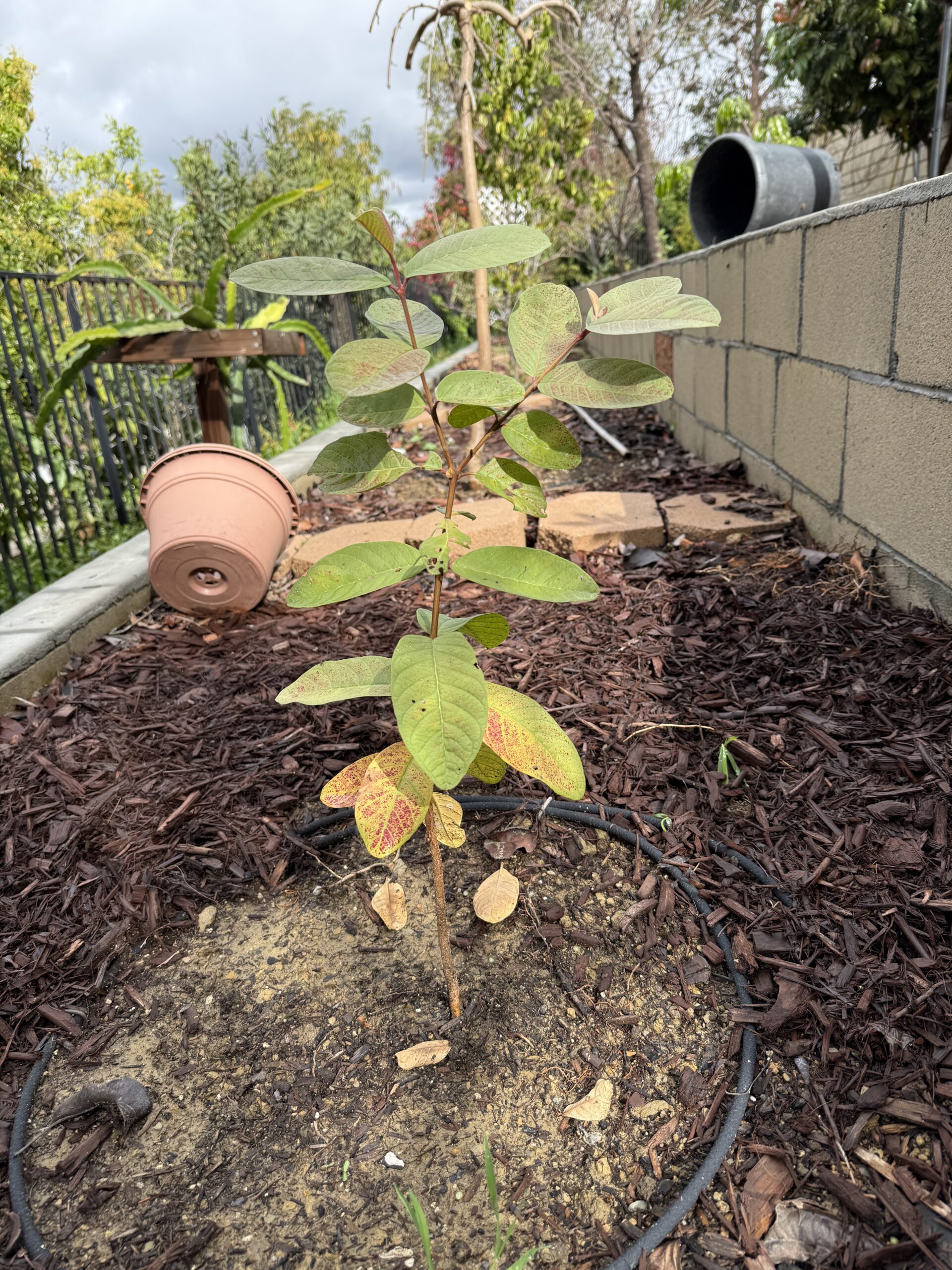
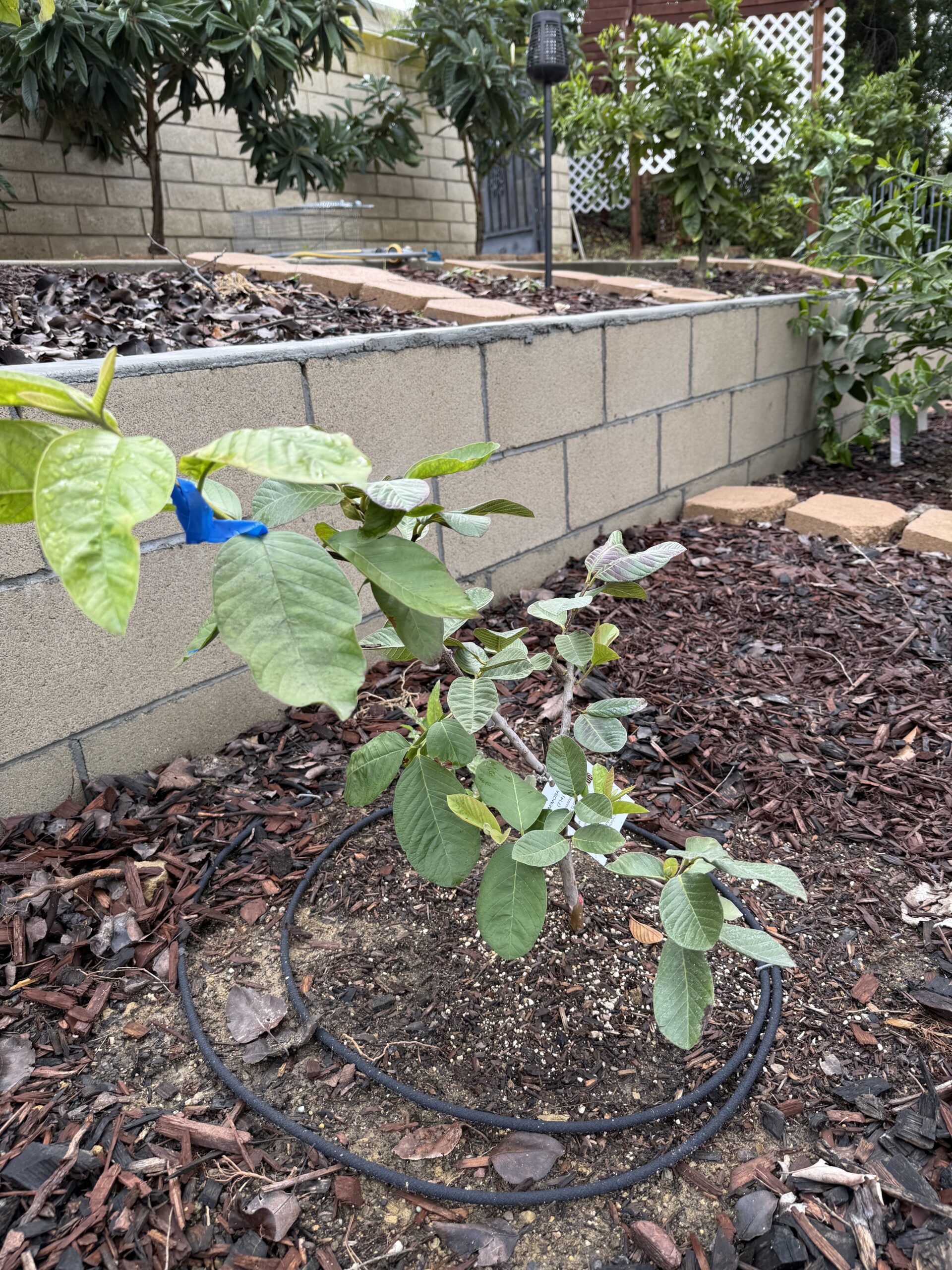
    • Appearance: As clearly seen in the photo, it has large, slightly corrugated leaves with very prominent veins. When mature, its trunk will also peel to reveal smooth, bronze-colored bark.
    • Growth Habits: It is an absolute heat-lover, thriving in the blazing Southern California summer sun. The trade-off is that it is extremely cold-sensitive as a young sapling. Once it fully establishes its roots in the Rowland Heights soil and survives the first couple of risky years, its growth rate will be astonishing.

    📅 My Planting Log

    • The Baby of the Orchard: It officially joined the orchard in the dead of winter, January 2026. You can still see the blue nursery tape holding a branch and the white plant tag at the bottom, proving just how “new” it is.
    • A Brave Winter Survivor: Looking closely at the photo, some leaves have a slight purplish or dark bronze tint. This is a completely normal stress response for tropical guavas experiencing cold winter temperatures (increased anthocyanin production to protect the leaves). For a sapling planted just last month, it looks very perky, upright, and without severe wilting, indicating it is holding its ground well.

    🛠️ My Care Guide (For Newly Planted Saplings)

    • Strict Winter Protection: This is a matter of life and death right now. Because it was just planted in January, its root system hasn’t expanded at all. If it encounters frost below 32°F (0°C), it will take a massive hit. I will closely monitor the weather forecast until spring truly arrives.
    • The Perfect Drip Ring: The circular drip irrigation line I set up around it in the photo is textbook perfect! This ensures water soaks evenly around the root zone. Since it’s a fresh transplant, I will keep the soil within this drip ring consistently slightly moist, but never waterlogged.
    • Remove Ties: Once it settles in a bit more, I will remember to untie or cut that blue plastic tape. This prevents the tape from girdling or cutting into the bark as the tree grows rapidly in the spring. The only job right now is to wait patiently for spring—strictly no fertilizer at this stage.
  • Strawberry Guava

    Strawberry Guava

    🍓 Plant Profile: Strawberry Guava

    📋 Basic Info

    • Variety Name: Strawberry Guava
    • Planted Date: August 2025 (Purchased from Mosac’s Market Store)
    • Yield Performance: ★☆☆☆☆ (Still a sapling under a year old, currently focusing on establishing roots)
    • Taste Profile: (Expected) The fruits are petite and exquisite, turning a beautiful purplish-red when ripe. The flavor is a delightful sweet-tart mix, perfectly blending the aroma of strawberries with the base notes of guava. You can eat them whole, skin and seeds included!

    📖 Variety Overview If you want to plant a fruit tree in California that will never let you down, the Strawberry Guava is top of the list. It functions as both a highly productive fruit tree and a highly ornamental evergreen shrub.

    • Appearance: It features rounded, thick, and glossy leaves. As it matures, the trunk peels to reveal a very smooth, beautiful camouflage-like texture, making it a great landscape plant.
    • Growth Habits: It is significantly more cold-tolerant than regular giant tropical guavas! It is perfectly adapted to the climate in Rowland Heights, boasts incredible vitality, and is practically pest-free. Once established, it is extremely low-maintenance.

    📅 My Planting Log

    • The New Kid on the Block: I brought it home from the market and planted it in late summer, August 2025. As of now, it’s been in the orchard for less than a year.
    • Baptism by Winter: Right now, it is at the tail end of its first winter. The yellowing and reddish older leaves at the bottom of the photo are a completely normal metabolic response to the colder weather. It smartly drops its older leaves to concentrate precious nutrients and water on the healthy, green growth at the top. It has successfully survived its first winter after transplanting!

    🛠️ My Care Guide (For the First Year)

    • Waiting for Spring (Spring Recovery): The priority right now is simply to let it be. The red and yellow leaves at the bottom will drop naturally, and as spring temperatures rise, it will soon trigger a strong flush of new growth.
    • Consistent Watering: The photo shows the drip irrigation line is already set up. Since it’s still a young sapling under a year old with a shallow root system, I will continue to keep the mulch layer around it slightly moist, ensuring it doesn’t dry out during the season transition.
    • Gentle Feeding: In a few weeks, once the weather warms up completely and I see obvious new buds pushing out, I will apply a very light dose of mild organic fertilizer to help it grow taller this spring.
  • Arkin Star Fruit

    Arkin Star Fruit

    Plant Profile: Arkin Star Fruit

    📋 Basic Info

    • Variety Name: Arkin Star Fruit (Inferred as the most likely market standard)
    • Planted Date: Fall 2024 (Purchased from Mimosa Nursery)
    • Yield Performance: ★☆☆☆☆ (Currently a first-year sapling focused on vegetative growth)
    • Taste Profile: (Expected) The classic sweet star fruit flavor. Mature fruits are golden yellow, crisp, juicy, purely sweet with no tartness, and have a floral aroma.

    📖 Variety Overview Arkin is the most famous and widely planted sweet star fruit variety in the US, making it an excellent choice for Southern California home orchards.

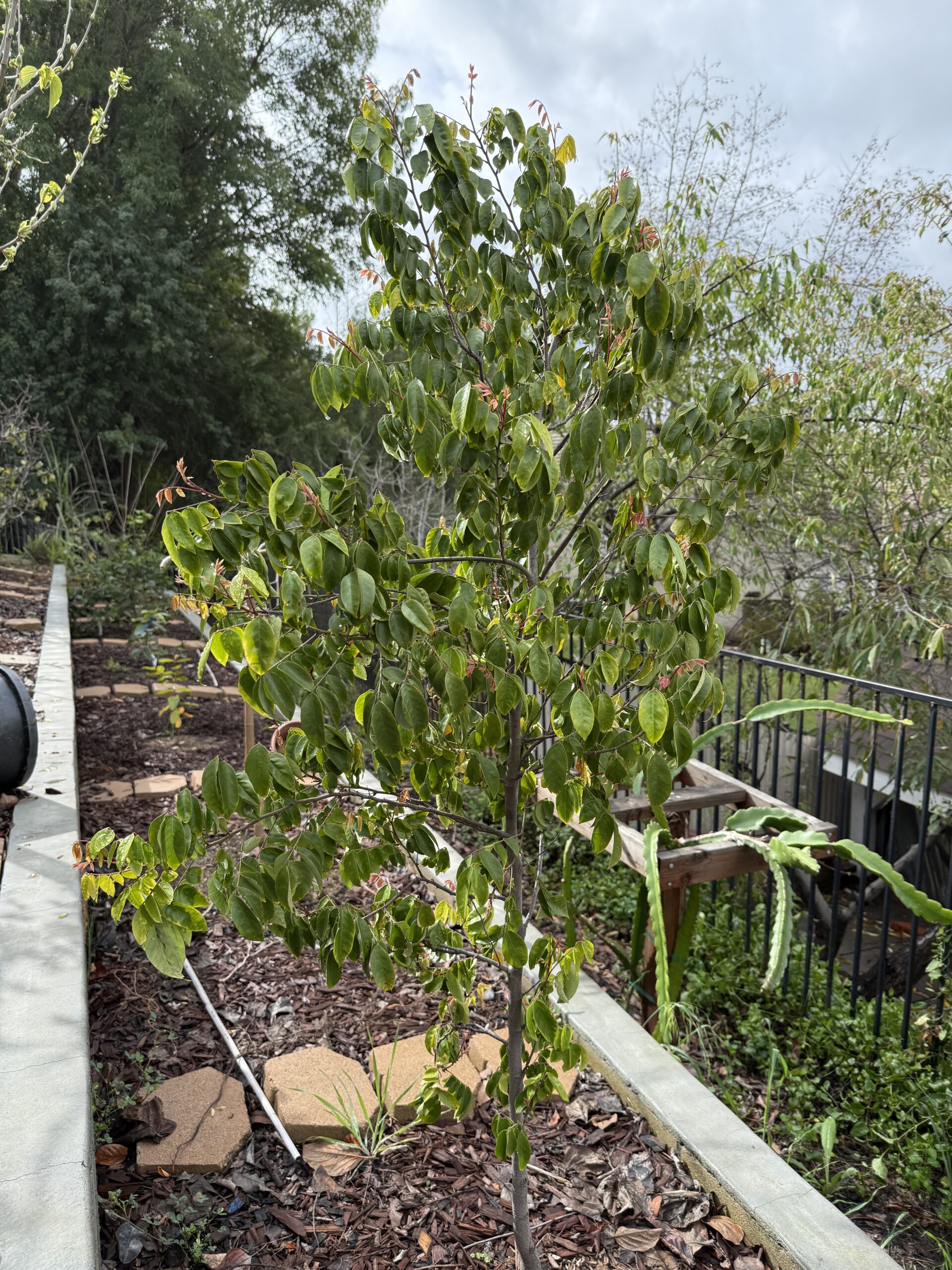
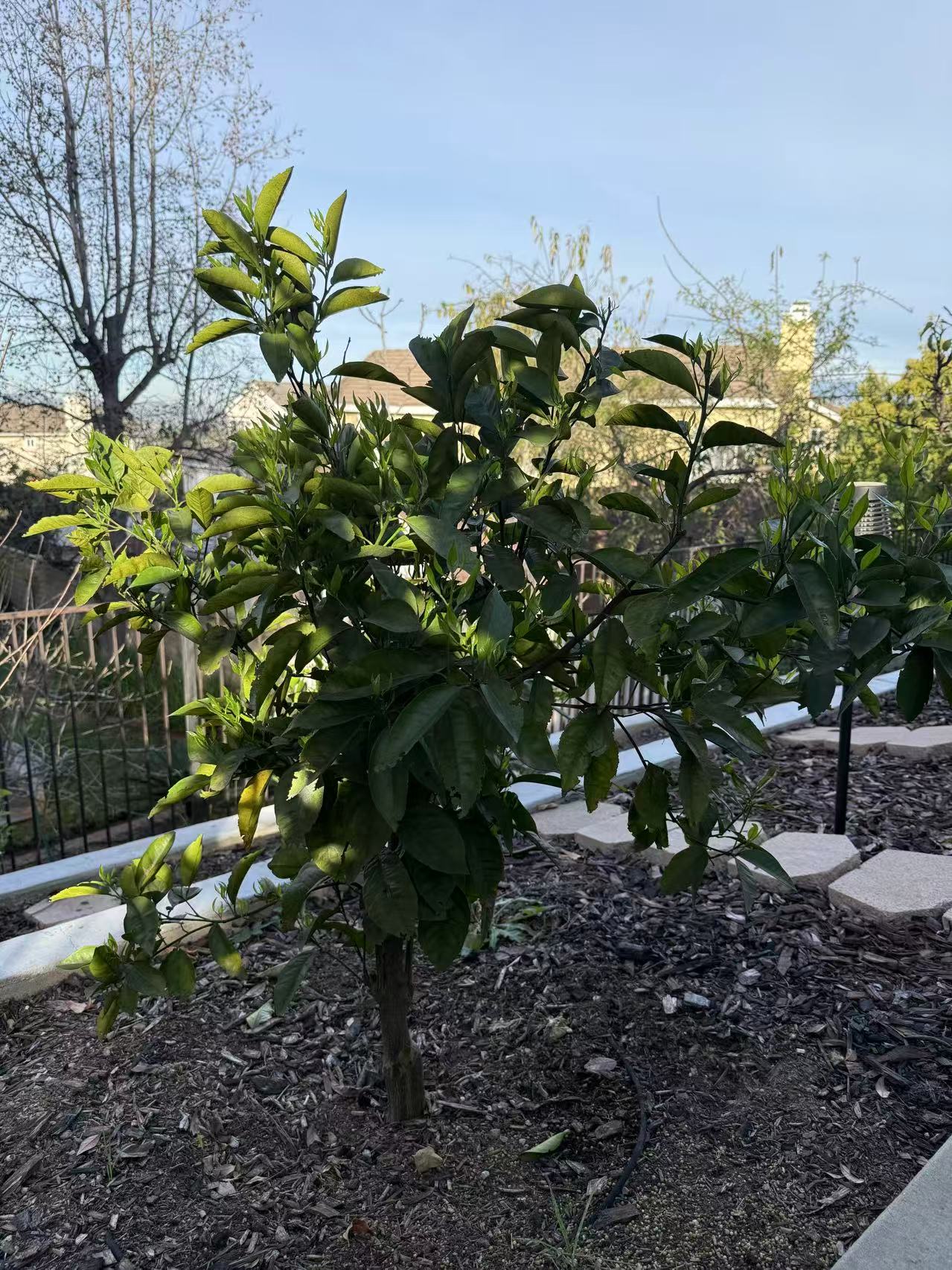
    • Appearance: It has a graceful tree form, and its leaves exhibit sleep movements (folding up at night or when touched). The reddish-brown new growth seen in the photo is a sign of vigor.
    • Growth Habits: It loves warm, sunny environments. The biggest challenge in Rowland Heights is winter protection. Once it survives the winters, it grows rapidly and is known for being highly productive when mature, often fruiting multiple times a year.

    📅 My Planting Log

    • A Vibrant New Member: Joined the orchard in the fall of 2024. As of February 2026, the photo shows a very healthy sapling with an upright form and lush foliage, showing no signs of pests or diseases.
    • Positive Growth Signals: Despite being winter, the numerous reddish-brown new shoots on its branches indicate that its root system has adapted well to the soil and it is actively engaging in vegetative growth. This is a very promising start.

    🛠️ My Care Guide (For Sapling Stage)

    • Critical Task: Frost Protection: Star fruit is a tropical plant and is highly sensitive to frost. For the first 2-3 years before it matures, winter protection is paramount. If temperatures are forecast to approach 32°F (0°C), I will cover it with frost cloth or apply a thick layer of mulch at the base for insulation.
    • Water Management: Star fruit prefers moist but well-draining soil and is very susceptible to root rot from waterlogging. As a sapling with a shallow root system, I will keep the soil consistently slightly moist, especially during dry or windy weather, to prevent it from drying out and wilting.
    • Wind Protection: Its branches are relatively brittle, and its leaves easily dry out in strong winds. While its trunk is still developing strength, I will be mindful of strong Santa Ana winds and provide support if necessary.
  • Mauritius Lychee

    Mauritius Lychee

    🍒 Plant Profile: Mauritius Lychee

    📋 Basic Info

    • Variety Name: Mauritius Lychee (Also known as “Tai So”)
    • Planted Date: Fall 2024 (Purchased from Mimosa Nursery)
    • Yield Performance: ★☆☆☆☆ (Currently in the post-transplant establishment phase, no yield yet)
    • Taste Profile: (Expected) Classic sweet-tart lychee flavor, juicy and aromatic. While the seed is larger than the “Sweet Heart” variety, it makes up for it with reliable production.

    📖 Variety Overview If growing lychee in Southern California is a test, Mauritius is the easiest question on the exam. It is the most adaptable and reliable bearing commercial variety for the local climate.

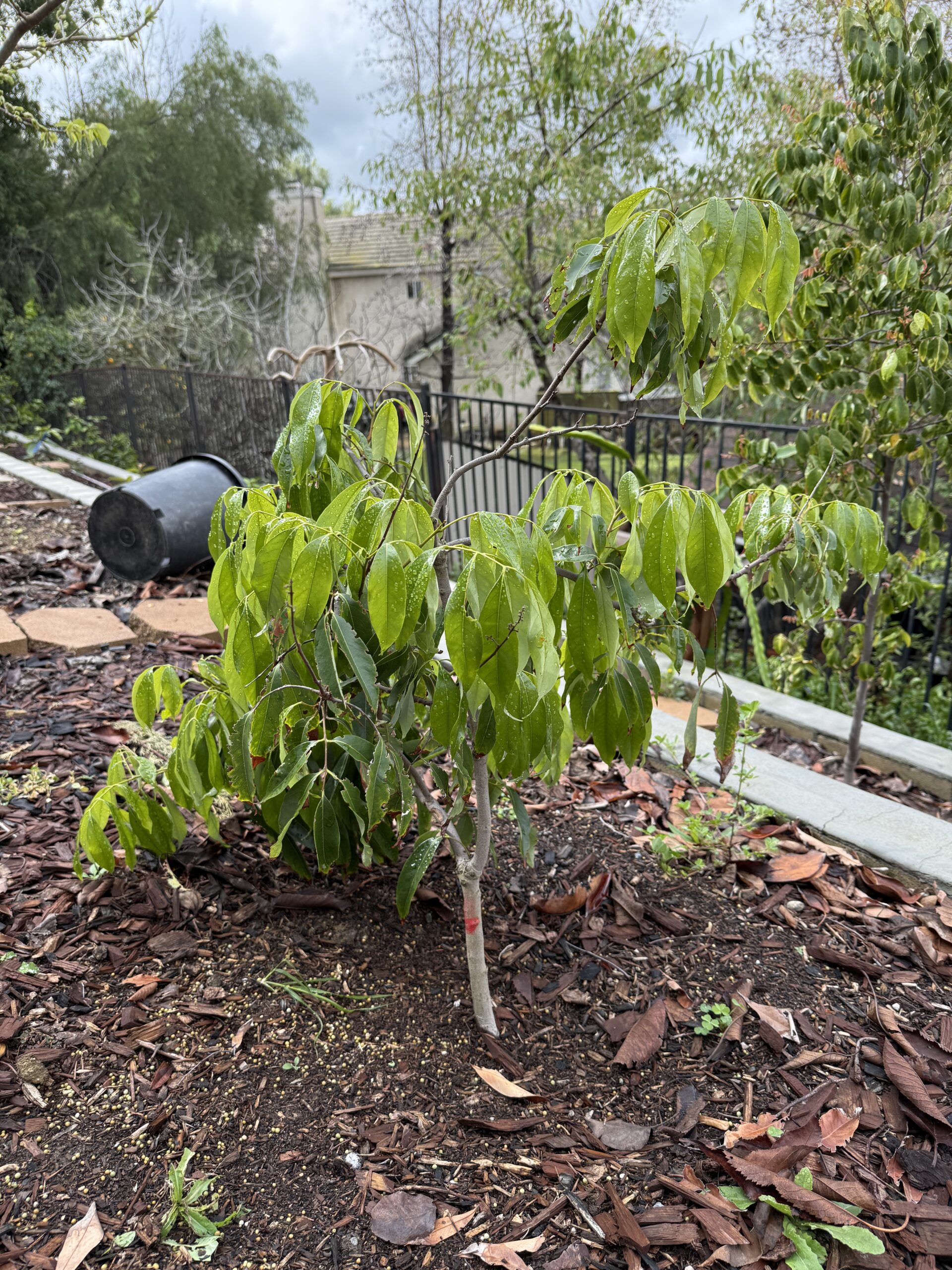
    • Appearance: As seen in the photo, its leaves are typically narrower and pointier than other varieties. The mature fruit has dark red skin, often ready to harvest even with a hint of green on the “shoulders.”
    • Growth Habits: It has relatively good tolerance for SoCal’s cool winters and dry summers. It doesn’t require as strict of a winter chill to induce flowering as other varieties, making it highly likely to fruit year after year.

    📅 My Planting Log

    • New Arrival: In the fall of 2024, this small sapling carrying dreams of tropical fruit arrived in the orchard. The photo clearly shows the graft union at the base, indicating it is a grafted tree with superior genetics.
    • Adaptation Period: It is currently navigating its first winter and early spring after planting. The slightly drooping leaves in the photo suggest it is working hard to adapt to the new soil and climate, a normal reaction after transplanting. Its primary goal right now is to establish its root system, not to grow tall.

    🛠️ My Care Guide (For First-Year Sapling)

    • Winter Protection: Lychee is a quintessential tropical plant and is very sensitive to cold. Although Rowland Heights is mild, during its first winter/early spring, if temperatures approach 32°F (0°C) during a cold snap, I must cover it with frost cloth. Its tender branches also need protection from strong winds.
    • Careful Watering: The root system of a newly planted sapling is underdeveloped. I need to keep the soil moist but never waterlogged. I will check the soil moisture frequently rather than sticking to a fixed schedule to prevent root rot.
    • Hold Off on Fertilizer: Until it pushes out significant new growth, its roots cannot absorb many nutrients. Applying fertilizer now could easily burn the roots. I will patiently wait until the weather warms up completely in spring and new leaves emerge before applying a very diluted liquid acid fertilizer.
  • Royal Lee Cherry

    Royal Lee Cherry

    🍒 Plant Profile: Royal Lee Cherry

    📋 Basic Info

    • Variety Name: Royal Lee Cherry
    • Planted Date: Early 2022 (Purchased as a sapling alongside Minnie Royal)
    • Yield Performance: ★★★☆☆ (Gathering strength, ready for a peak production phase with its partner)
    • Taste Profile: Exceptionally sweet California red cherry with firm flesh and rich flavor, the perfect complement to Minnie Royal.

    📖 Variety Overview The Royal Lee is the other half of Southern California’s famous low-chill cherry duo. If Minnie Royal is the early bird, Royal Lee is the steady anchor.

    • Appearance: It has an upright growth habit. Its chill hour requirement is slightly higher than its partner’s (around 250-350 hours), so it wakes up a bit later in the spring. The ripe fruits are deep red and beautifully heart-shaped.
    • Flavor: Its sugar content ranks among the highest in the cherry family. It has a satisfying crunch, making it absolutely perfect for eating fresh.
    • Growth Habits: It thoroughly enjoys the warm sunshine of Rowland Heights. It is strictly not self-fertile and relies entirely on pollen from the Minnie Royal to produce a bountiful harvest.

    📅 My Planting Log

    • Witness to Four Years of Growth: Taking root in the orchard alongside Minnie Royal in early 2022, this former frail sapling has grown robust over the past four years and is now steadily stepping into its prime fruit-bearing years.
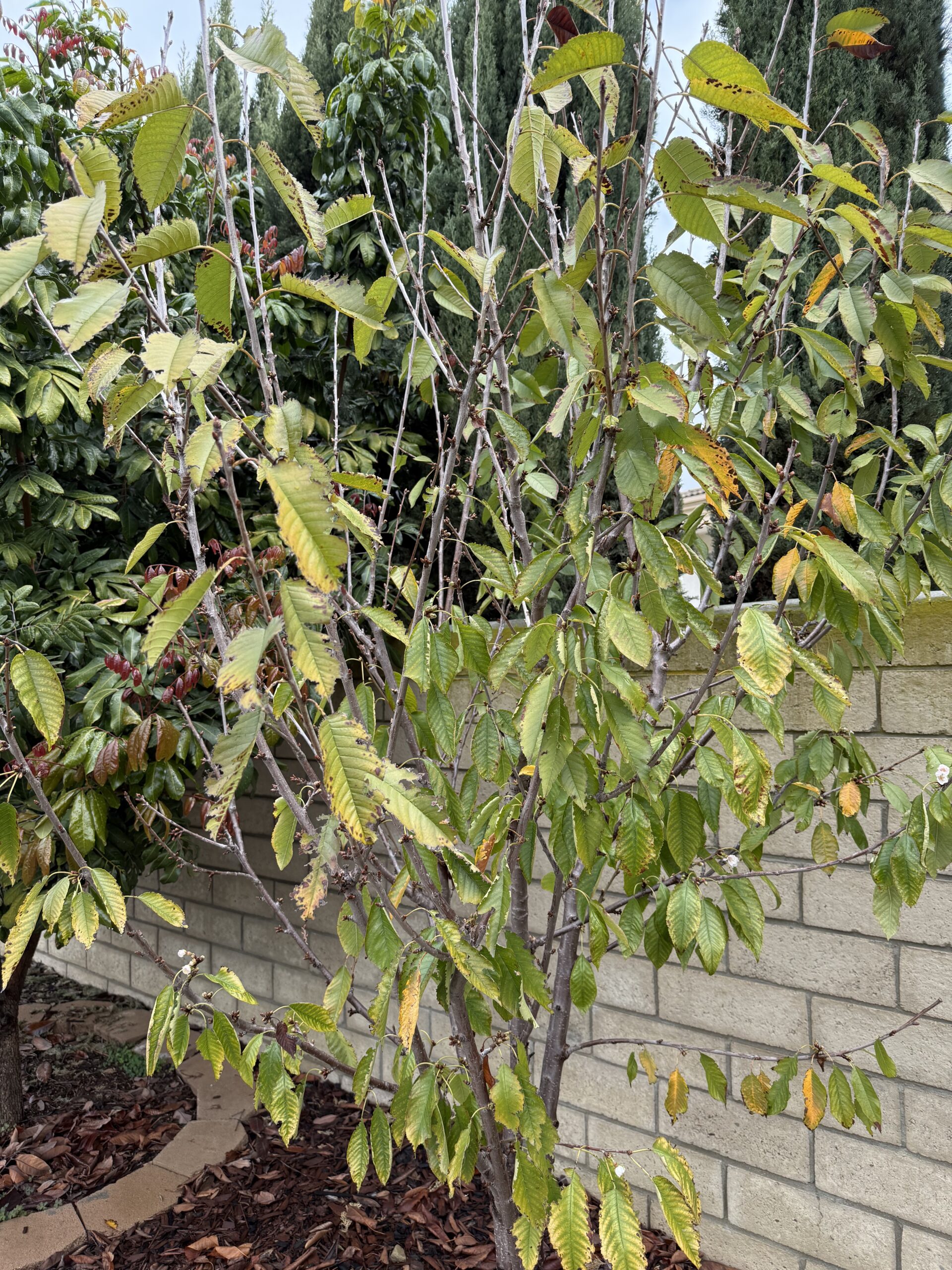
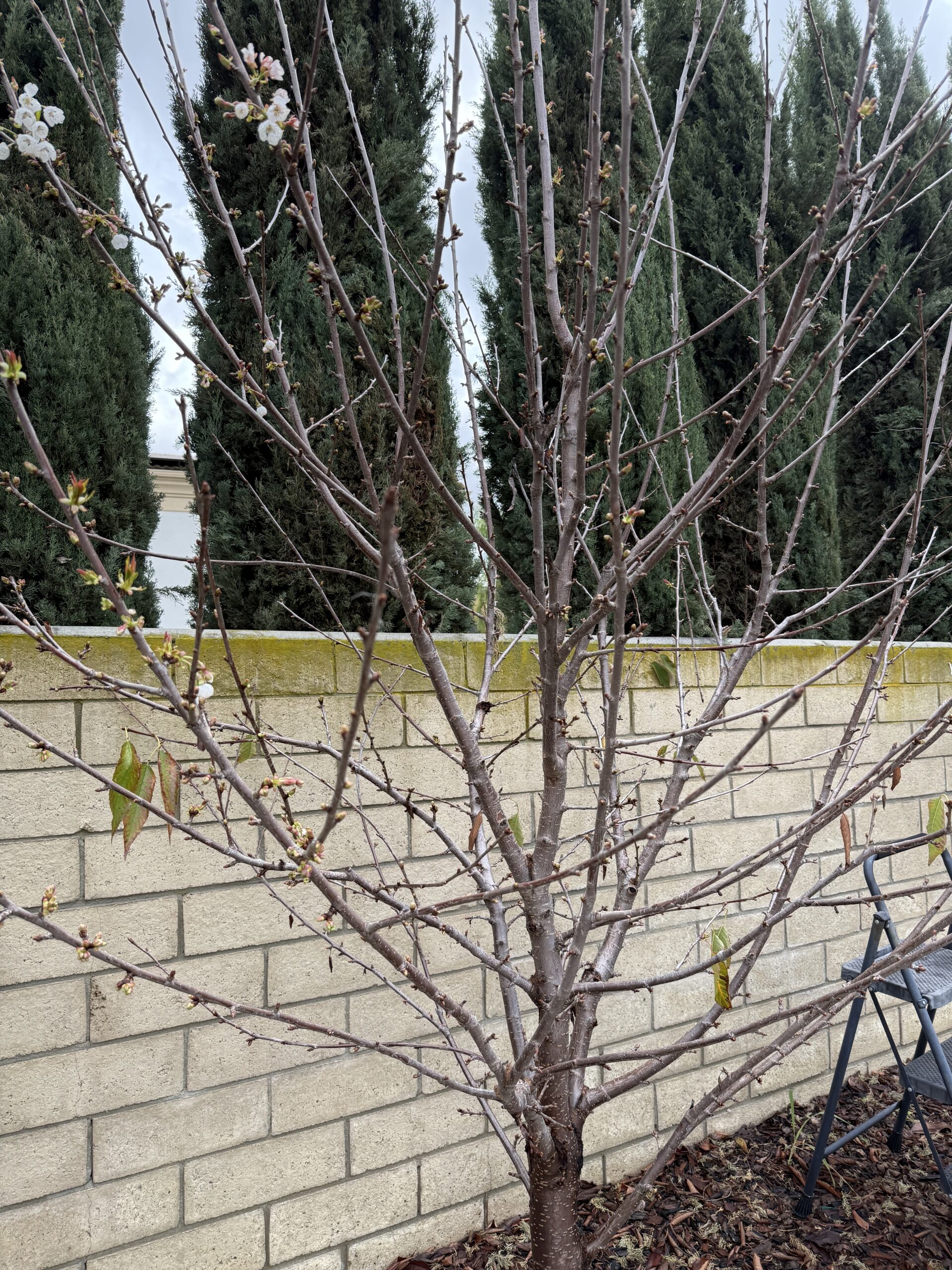
    • The Lingering Old Leaves: Its growth rhythm is half a beat slower than its partner. In mid-February of this year, while the neighboring Minnie Royal was already covered in blossoms, this tree was like a sleepy child, still holding onto some withered old leaves from last year. This “marcescence” is common in Southern California’s mild winters, indicating it’s still gathering strength.
    • A Late Bloom: Its bloom period is usually 10 to 14 days later than Minnie Royal (typically late February to early March). Although it starts late, it perfectly catches the tail end of its partner’s bloom to complete that crucial pollination handover.

    🛠️ My Care Guide

    • Manual Leaf Removal: To prepare for the upcoming bloom, I will manually pick off those stubborn old leaves lingering on the branches. This not only eliminates hiding spots for spider mites and powdery mildew spores but also allows direct sunlight to reach the branches, stimulating flower bud emergence.
    • Precision Pollination: Once it finally blossoms, I will seize the critical window to manually transfer pollen from the late-stage Minnie Royal flowers onto this tree with a small brush, ensuring this “low-chill duo” produces the maximum yield.
    • Synchronized Water & Fertilizer: Even though it wakes up later, the drip irrigation system underneath will stay synchronized with its partner. Once it blooms and pushes new growth, I will follow the principle of “light but frequent” organic feeding to build up abundant energy for the fruit expansion phase.
  • Minnie Royal Cherry

    Minnie Royal Cherry

    🍒 Plant Profile: Minnie Royal Cherry

    📋 Basic Info

    • Variety Name: Minnie Royal Cherry
    • Planted Date: Early 2022 (Purchased as a sapling alongside Royal Lee)
    • Yield Performance: ★★★☆☆ (Entering its peak production phase after four years of root establishment)
    • Taste Profile: Classic California sweet cherry flavor. Features bright red skin, firm and plump flesh, and exceptional sweetness.

    📖 Variety Overview The Minnie Royal is a star variety specifically bred for warm, low-chill environments like Southern California. It is the missing piece to achieving “cherry freedom” right in our local backyard.

    • Appearance: It boasts a graceful canopy and has the distinct trait of “blooming before leafing out.” In early spring, the bare branches are covered in pure white cherry blossoms, which later give way to medium-sized, bright red fruits.
    • Flavor: It has a very high sugar accumulation with almost no tartness. Crisp and juicy, it is the family’s most anticipated fresh fruit of the early summer.
    • Growth Habits: It requires very low chill hours (only 200-300 hours) and thrives in the abundant sunlight of Rowland Heights. However, it cannot stand alone; it strictly requires a nearby cross-pollinator to bear fruit.

    📅 My Planting Log

    • Witness to Four Years of Growth: Back in early 2022, it was just an unassuming little sapling. After four years of soaking up the California sun and receiving careful attention, it has shed its immaturity and now shows massive yield potential.
    • The Early Spring Frontrunner: It is the most sensitive plant to spring in the entire orchard. Right now, in mid-February, while other fruit trees are still dormant, it has already burst into full bloom, officially kicking off spring in the garden.
    • A Decisive Character: Its growth rhythm is incredibly clear-cut. When winter arrives, it decisively drops all its old leaves to allow nutrients to fully return to the roots. Currently, the tree is completely bare of leaves but full of blossoms, showing a perfectly healthy reproductive state.
    • An Inseparable Pair: I bought this sapling specifically to pair it with the Royal Lee. Although Minnie Royal is impatient and typically blooms 10 to 14 days earlier, its bloom period is long enough to patiently wait for the Royal Lee to wake up and complete the pollination mission.

    🛠️ My Care Guide

    • Pollination Assist: Since it blooms so early in mid-February, temperature fluctuations mean there might not be enough active bees around, and the Royal Lee isn’t fully open yet. To guarantee a good harvest, I will gently sweep a small brush between the flowers, or intervene once the other tree blooms to ensure proper fruit set.
    • Water Management During Bloom: Blooming consumes a massive amount of water and energy. I will carefully check the drip irrigation system during this period to keep the soil slightly moist—preventing massive flower drop from drought, while also avoiding root rot from waterlogging.
    • Post-Bloom Care & Pest Control: Once the flowers fade and new leaves and tiny fruits emerge, it will be hungry for nutrients. I will apply a specialized organic fruit tree fertilizer. I will also ensure good ventilation around the canopy to prevent common spring aphid infestations.
  • Orchard Diary: Winter Pruning & Soil Care

    Orchard Diary: Winter Pruning & Soil Care

    ✂️ Orchard Diary: Winter Pruning & Soil Care

    📍 Core Task Info

    • Task Name: Winter pruning, orchard clearing, and basal fertilization.
    • Best Timing: December to February (The golden dormancy period for fruit trees in Southern California).
    • Target Objects: Clearing dead wood for deciduous trees (peaches, jujubes, figs), vines (grapes, blackberries), and evergreen trees (citrus, avocados).
    • Core Purpose: Storing energy, improving light penetration, breaking the pest overwintering cycle, and laying a solid foundation for explosive blooming and fruiting in the spring.

    📖 Why is Winter Care So Important?

    In California, although we don’t have severe freezing winters, the deciduous plants in the orchard still enter a precious dormancy period as temperatures drop and daylight shortens. Sap flow is slow right now, making it the absolute best time to bring out the pruning shears.

    • Reallocating Energy: Pruning leggy and excess lateral branches forces the fruit trees to direct their limited nutrients strictly to the flower buds in the spring. This directly determines your yield and fruit size for the year.
    • Establishing a Microclimate: Early spring in Southern California often brings rain. Timely thinning of the inner canopy allows ventilation and sunlight to penetrate, which greatly reduces the chance of fungal infections.
    • Soil Recharging: After a full year of crazy growth and heavy fruiting, the soil nutrients are heavily depleted. Applying basal fertilizer during the winter rainy season allows the moisture to slowly carry organic matter deep into the root zone.

    📓 My Orchard Practice Record

    January and February are my busiest, yet most enjoyable, times in the orchard. Watching each tree shed its messy overgrowth under my shears and reveal a clear, strong structure is like carving a piece of art.

    • “Major Surgery” for the Deciduous Group: The White Peach, Donut Peach, and Big-Fruit Hawthorn are my primary focus. I ruthlessly cut off crossing and inward-growing branches to train the canopy into an “Open Center” shape, allowing direct sunlight to reach the inside. The Black Mission Fig and Shanxi Jujube also get appropriate heading back to control their height and stimulate new shoots.
    • “Out with the Old” for the Vines: The pruning principles for the Kyoho Grape and Triple Crown Blackberry are simple but must be firm. I cut the grayish-white old vines that fruited last year right down to the base, and tie the newly emerged, strong green vines evenly onto the white trellis.
    • “Fine-Tuning” the Evergreen Group: The Washington Navel, Valencia Orange, and Hass/Fuerte Avocados are still lush and green in the winter. For them, I only do very light pruning: removing dead, diseased, or weak branches in the inner canopy, as well as low-hanging branches touching the ground, to prevent soil-borne pathogens from splashing onto the leaves.

    🛠️ Key Technical Points

    • Sanitize Tools (Prevention First): Between pruning different trees, I always wipe my pruning shears with rubbing alcohol spray or wipes. Especially during the California winter rainy season, unsterilized shears can easily become an accomplice in cross-spreading citrus canker or other diseases.
    • Thorough Orchard Clearing: Pruned dead branches, fallen leaves on the ground, and mummified fruits (mummies) left on the trees must all be cleared out of the orchard. This is the most effective physical method to cut off the overwintering lifeline for pests like the Oriental fruit moth and leafminers.
    • “Chop and Drop” for Banana Trees: After harvesting the Ice Cream Bananas, the mother plant loses its purpose. I decisively chop it down, cut it into chunks, and pile them directly at the base of the banana clump. They are rich in water and potassium, making them an excellent natural fertilizer.
    • Winter Feeding & Mulching:
      • Fertilizing: Shallowly bury composted chicken or cow manure around the drip line to provide sufficient NPK (Nitrogen, Phosphorus, Potassium) for spring budding. For acid-loving plants like the O’Neal Blueberry, this is also the perfect time to add a soil acidifier.
      • Mulching: After fertilizing, apply a 2-3 inch thick layer of wood mulch over the exposed soil throughout the orchard (making sure to keep it a few inches away from the actual tree trunks). This not only insulates against the winter chill but prepares the soil to retain moisture for the upcoming dry, hot summer.
  • Clock of clocks 288

    Clock of clocks 288

    Clock of Clocks 288

    by Lucas Lu

    Conceptual Design

    Design Sketch

    Final Construction

    Finished Product

    The Inspiration

    When I first encountered the A Million Times clock, I was instantly captivated. Hundreds of independent hands dancing in perfect synchronization to form digits and waves—it felt like watching mechanical magic. However, the premium price tag was a significant barrier. Driven by curiosity and a “maker” spirit, I decided to build my own 24 x 12 matrix version from scratch.

    System Architecture

    This massive kinetic installation is powered by a distributed control network of 73 microcontrollers:

    • Master (Arduino Mega): The brain. It connects to NTP servers via WiFi to fetch precise time and maps it onto a 12×24 coordinate system. It manages 9 distinct animation patterns (Waves, Rectangles, Random patterns) and dispatches target positions to 72 slave nodes over the I2C bus.
    • Slaves (72x Arduino Nano): The muscle. Each Nano acts as an I2C slave node, controlling 4 dual-shaft stepper motors (8 independent hands per node). They handle high-frequency step generation and real-time sensor monitoring.

    Engineering Breakthrough: Closed-Loop Calibration

    Standard stepper motors operate in an “open-loop” fashion. Without feedback, a single skipped step or power flicker would permanently de-sync the clock hands.

    To solve this, I integrated a Hall Effect Sensor Matrix into the custom PCB. Each clock hand contains a tiny neodymium magnet, and two Hall sensors are positioned along its rotation path.

    My V2.0 firmware implements a “Silent Calibration” logic: instead of a clunky global reset, the Arduino Nano monitors the exact moment the magnet passes the sensor. By calculating the average trigger position, the system determines the position_diff. If an error exceeding 2 degrees is detected, the slave node automatically compensates for the drift during its next movement, ensuring the array remains perfectly aligned 24/7.

    Open Source & Code

    This project is fully open-sourced for the geek community. Below are snippets of the logic managing the distributed time distribution and the real-time sensor feedback.

    ► Master Controller Logic (NTP to Matrix Mapping)
    // Core logic: Mapping digits to the 12×24 array void showDigits() { int h1 = currentTime.getHour() / 10; int m2 = currentTime.getMinutes() % 10; // Mapping predefined digit arrays to the global ‘base’ matrix for (int i = 0; i <= 5; i++) { for (int j = 0; j <= 4; j++) { base[i + 3][j + 1][0] = digits[h1][i][j][0]; // ... further mapping for h2, m1, m2 } } // Sending 8-byte position data to 72 slaves via I2C for (int i = 1; i <= 72; i++) { Wire.beginTransmission(i); Wire.write(sendData, 8); Wire.endTransmission(); } }
    ► Slave Feedback Logic (Hall Sensor Calibration)
    // Core logic: On-the-fly calibration using Hall sensors void loop() { // Read sensor state (Digital/Analog hybrid detection) tempVal = (digitalRead(hall_sensors[i]) == LOW) ? 1 : 0; if (tempVal != hall_flags[i]) { hall_flags[i] = tempVal; hall_positions[i][tempVal] = position_current[i]; if (tempVal == 0) { // Triggered on magnet exit // Calculate deviation between physical and logical position position_diff[i] = STEPS – (hall_positions[i][0] + hall_positions[i][1]) / 2; // Apply offset compensation if threshold is met if (position_diff[i] > 24 && position_diff[i] < STEPS - 24) { position_current[i] = (position_current[i] + position_diff[i]) % STEPS; } } } }
  • Valencia Orange

    Valencia Orange

    🍊 Plant Profile: Valencia Orange

    📊 Basic Information

    • Variety Name: Valencia Orange
    • Planting Time: Early 2022 (The second pioneer tree in my orchard)
    • Yield Performance: ★☆☆☆☆ (Currently recovering from early root damage, similar to its neighbor, the Washington Navel)
    • Taste Characteristics: Known as the “King of Juice”; extremely juicy with a rich flavor and a perfect sweet-tart balance.

    📖 Variety Introduction While the Washington Navel is the king of fresh eating, the Valencia is the undisputed champion for juicing.

    • Appearance: The fruit is round with a thin, smooth rind. It has a unique “re-greening” trait where ripe fruit can turn slightly green again in warm weather without losing quality.
    • Flavor Profile: It boasts a very high juice content and few seeds, making it the top choice worldwide for orange juice.
    • Growth Habit: It loves the sun and warmth of Rowland Heights. As a late-season variety, its fruit typically matures in the summer, perfectly following the spring-harvested Navels.

    📝 My Planting Record

    • Companion in Adversity: This was the second tree I ever planted. Because I planted it right next to the Washington Navel while I was still a novice, it suffered the same root damage from my lack of experience.
    • Synchronized Recovery: After three years of struggling, I finally saw signs of life returning in early 2025. Even though it’s currently battling aphids and leafminers, seeing those new spring buds is a huge relief.
    • The Tuition of a Novice: These two trees represent my growth from a complete beginner to a confident orchardist. Their early injuries were the “tuition” I paid for my education, and their recovery is my reward.

    🛠️ My Care Essentials

    • Dual Pest Defense: Since these trees are planted together, pests can easily spread between them. I use a synchronized treatment of organic Neem Oil on the new growth to keep aphids and leafminers at bay.
    • Root Rehabilitation: I am continuing a gentle root-boosting regimen to ensure these veterans can finally establish a deep, stable root system this year.
    • Summer Irrigation: Because Valencia oranges mature during the hot Rowland Heights summers, I pay close attention to consistent watering to prevent fruit drop during heatwaves.
    • Minimal Pruning: My current priority is building the tree’s strength. I only prune away leaves that are severely damaged by pests, allowing the healthy green foliage to maximize energy production through photosynthesis.